At a glance
- Lead a six-person senior design team for the NASA-funded Colorado Space Grant Consortium, and own the system architecture.
- Split the wearable into a wrist sensor module and a head-mounted LoRa radio, recovering up to 20 dB of link budget the body would absorb. First range test: 380 m across campus on basic antennas.
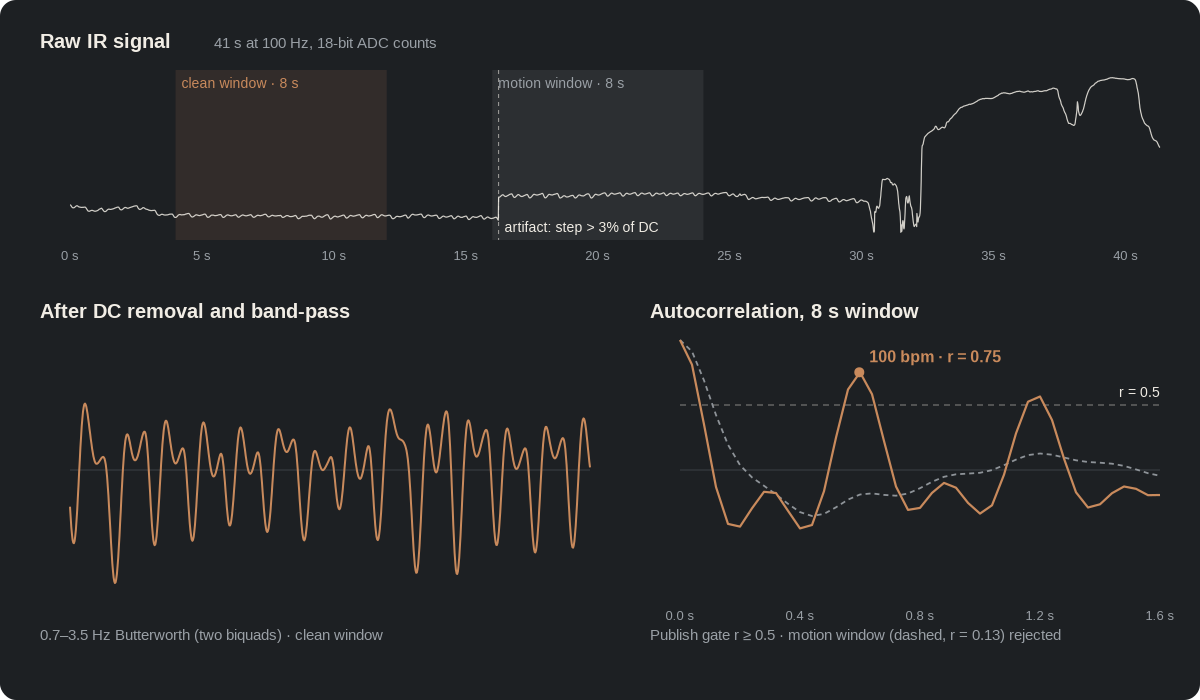
- Wrote the heart-rate firmware: artifact gating, a Butterworth band-pass and autocorrelation. On a real recording it reports 100 bpm (r = 0.75) and withholds a motion-corrupted window (r = 0.13).
- Designed and brought up a dual-battery power board in Altium in five days.
Works todayThe heart-rate pipeline on an ESP32-C6 breadboard, streaming to a live dashboard, and a LoRa link tested to 380 m. Custom sensor breakouts are in development.
Overview
The Astronaut Biometric Sensor relays the vital signs of analog astronauts back to a base station during remote field tests. The data shows how different suits, environments and mission profiles affect the people inside them, supporting the NASA-funded Colorado Space Grant Consortium's work toward real space missions.
The consortium's requirements are a range of at least 500 m, comfort, ease of use, low weight and ruggedness. The system is currently at the breadboard stage, with custom sensor breakouts in development. The deliverable is due at the end of 2026, followed by a public expo at the end of the school year.
System architecture
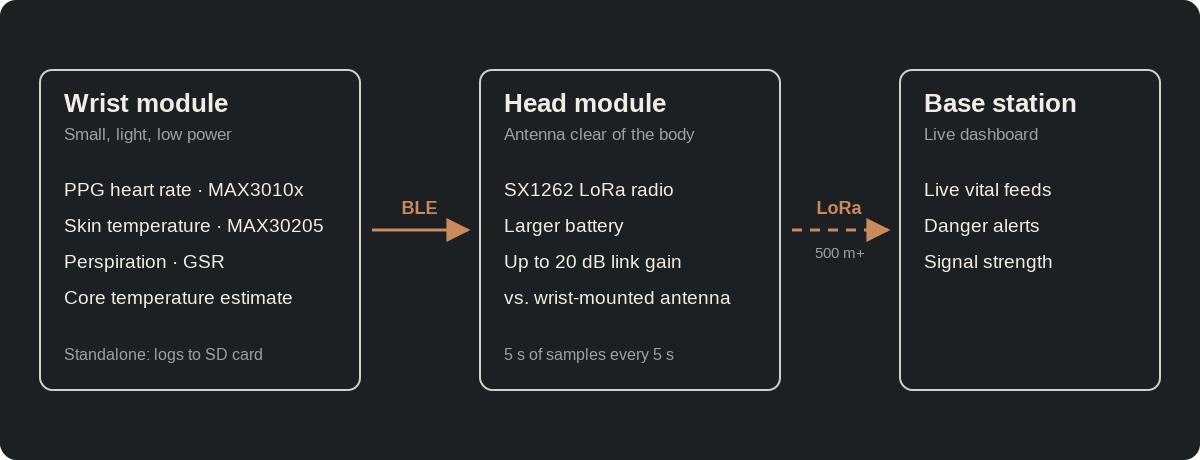
The system is split into two wearable modules. A wrist module carries the sensors and passes its readings over Bluetooth Low Energy to a head-mounted module, which transmits them to the base station over SX1262 LoRa. Moving the antenna off the wrist and away from the body recovers up to 20 dB of link budget that body mass would otherwise absorb. The split also lets the wrist module stay small, light and low-power, while the head module carries the larger battery the radio needs.
LoRa meets the range requirement without relying on infrastructure at remote test sites: the minimum is 500 m, and the goal is several kilometers. The first range test reached 380 m across campus with basic antennas, through heavy interference; longer tests will follow once the new antennas arrive. The nRF52840 was chosen for its built-in Bluetooth and low power draw. To respect LoRa airtime limits and save power, readings are batched rather than streamed: every five seconds, the head module sends the previous five seconds of samples. When long-range telemetry isn't needed for a mission, the wrist module runs standalone and logs to an SD card.
Sensing
Heart rate is measured optically with a MAX30101 PPG sensor, skin temperature with a MAX30205, and perspiration as skin resistance with a galvanic skin response (GSR) sensor.
Core body temperature is estimated from these other signals rather than measured directly. Very little prior work exists on estimating core temperature this way, which makes it the most exploratory part of the project.
Heart-rate signal chain
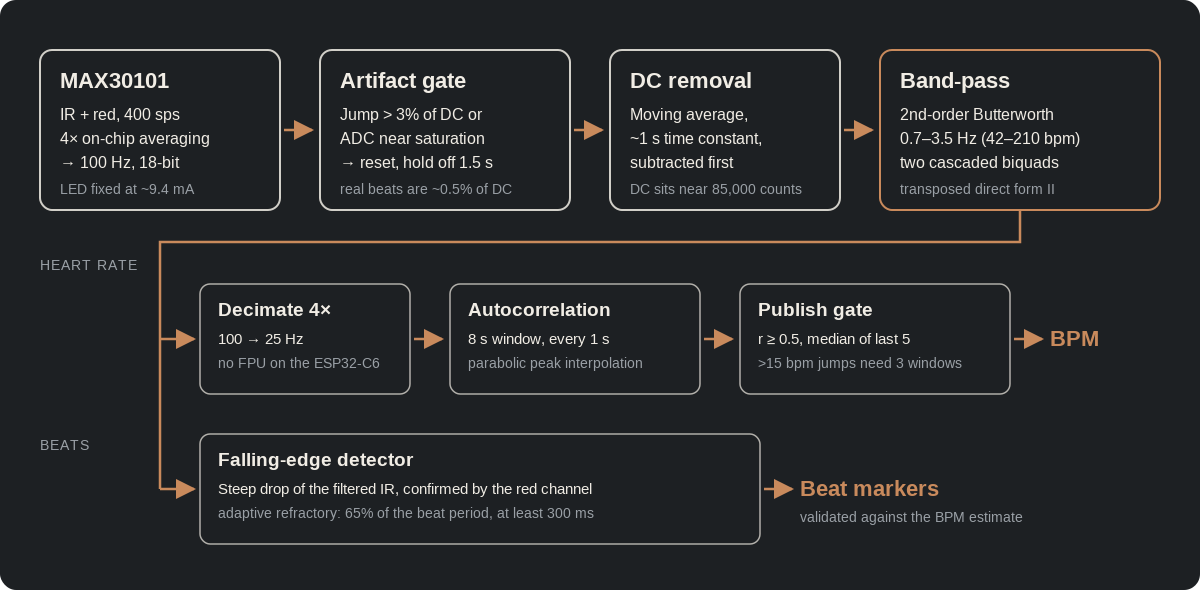
Before integration, I developed standalone firmware to bring up and tune my sensors in isolation, streaming raw samples over Bluetooth to a live dashboard. The heart-rate path went through several iterations. The current version runs on an ESP32-C6 with a MAX30101 sampling infrared and red light at 400 samples per second, averaged on-chip to 100 Hz.
Each sample first passes an artifact gate. A jump larger than 3% of the DC level, or a reading near ADC saturation, means the finger moved or lifted, so the filters and analysis window reset and detection pauses for 1.5 s. The slowly varying DC level is then removed with a one-second moving average, and a second-order Butterworth band-pass, implemented as two cascaded biquads, keeps 0.7–3.5 Hz: the band of a 42–210 bpm pulse.
Heart rate comes from autocorrelation rather than from counting individual beats. The filtered signal is decimated to 25 Hz, because the ESP32-C6 has no floating-point unit and a full-rate estimate overflowed the sensor's FIFO. Once per second, an 8-second window is autocorrelated and parabolic interpolation refines the peak lag. An estimate is published only if the window is strongly periodic (r ≥ 0.5); jumps of more than 15 bpm must persist for three windows, and the output is the median of the last five. Individual beats are marked separately by a falling-edge detector, corroborated by the red channel and limited by an adaptive refractory period.
LED drive current is fixed at about 9.4 mA. An earlier automatic-gain loop stepped the current whenever a normal beat valley crossed its threshold, injecting steps several times larger than the pulse itself. Motion artifacts remain the main open problem.
Base station
I built a prototype of the base-station dashboard. It shows live feeds of each vital sign, flags readings that cross into dangerous ranges, and reports signal strength. The final version is planned on Node.js.
Leading the team
As team lead and system architect, I make the architecture decisions and decide where each person fits. Much of the job is matching people to work that suits them, pairing people whose skills complement each other, and saying no to ideas that aren't the focus right now so the team keeps moving.
That applies to my own ideas too. Early on I designed a redundant dual-battery power board, then cut the redundancy from the design: the chance that a mission would actually need a second LiPo was low, and it wasn't worth carrying the extra hardware.
Power system exploration
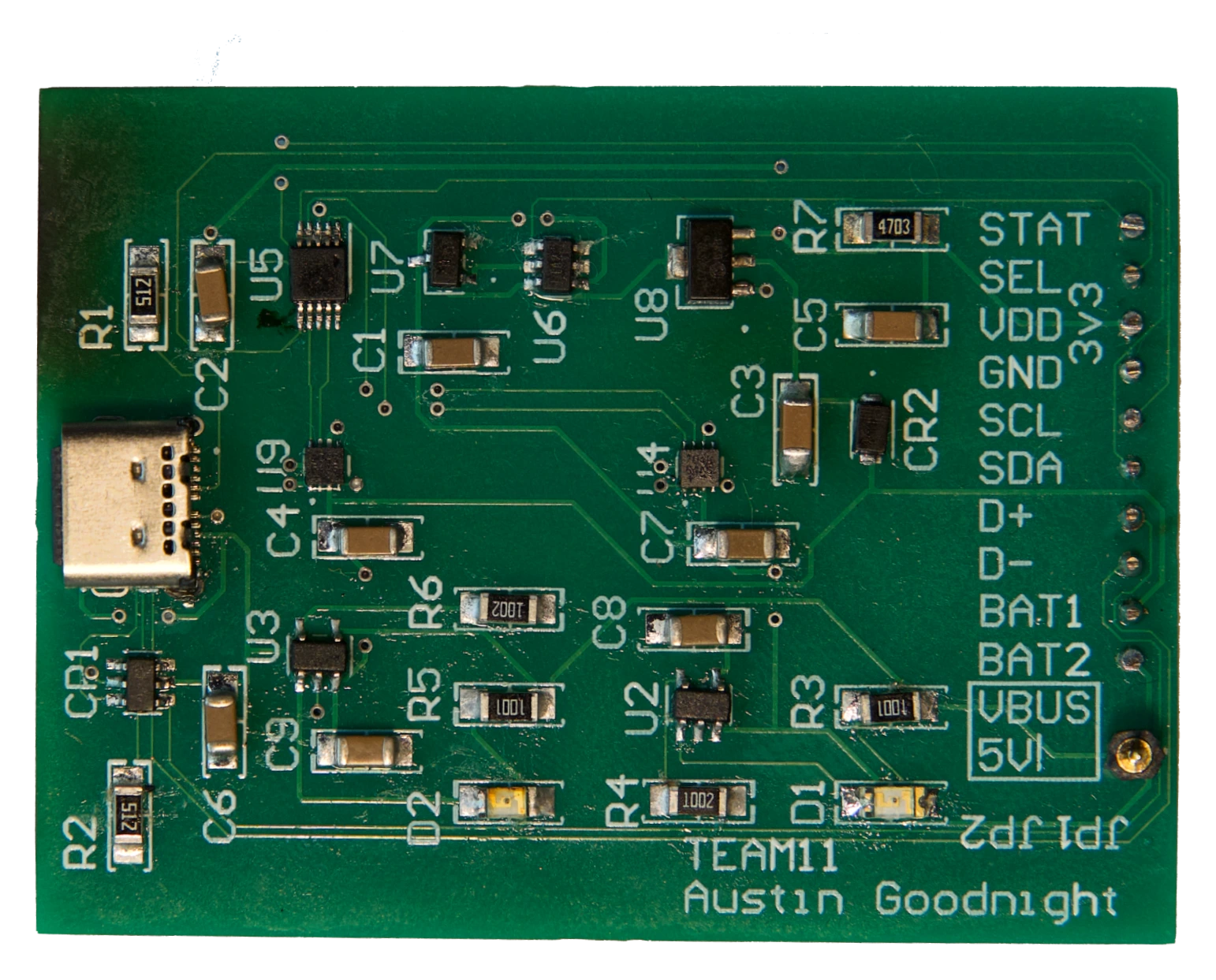
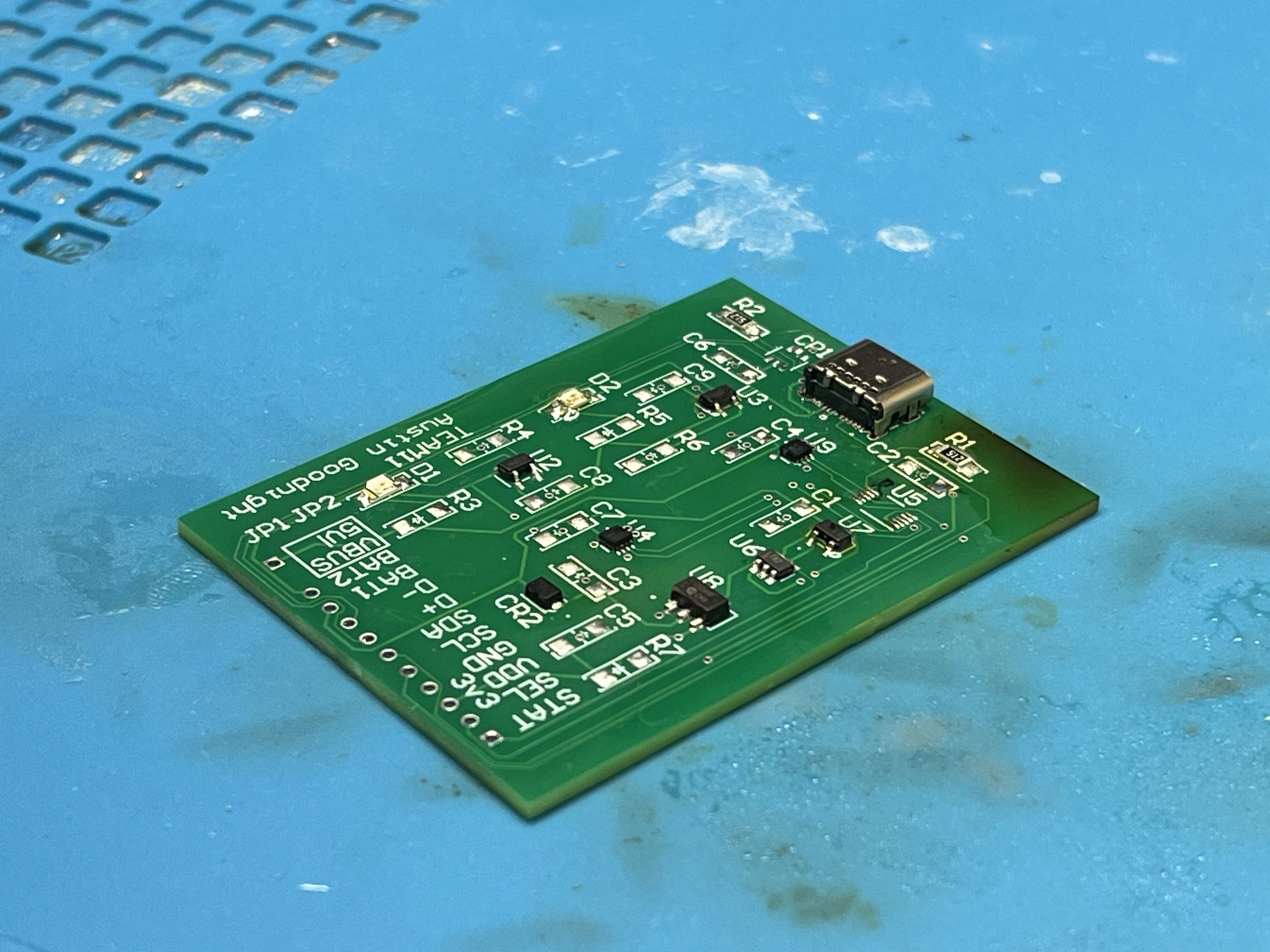
Early in the project I designed a redundant power board in Altium in five days. It ran from two LiPo cells, each with its own MCP73831 charger and MAX17048 fuel gauge, with an LTC4412 ideal-diode controller switching between batteries automatically and a 3.3 V LDO supplying the system rail.
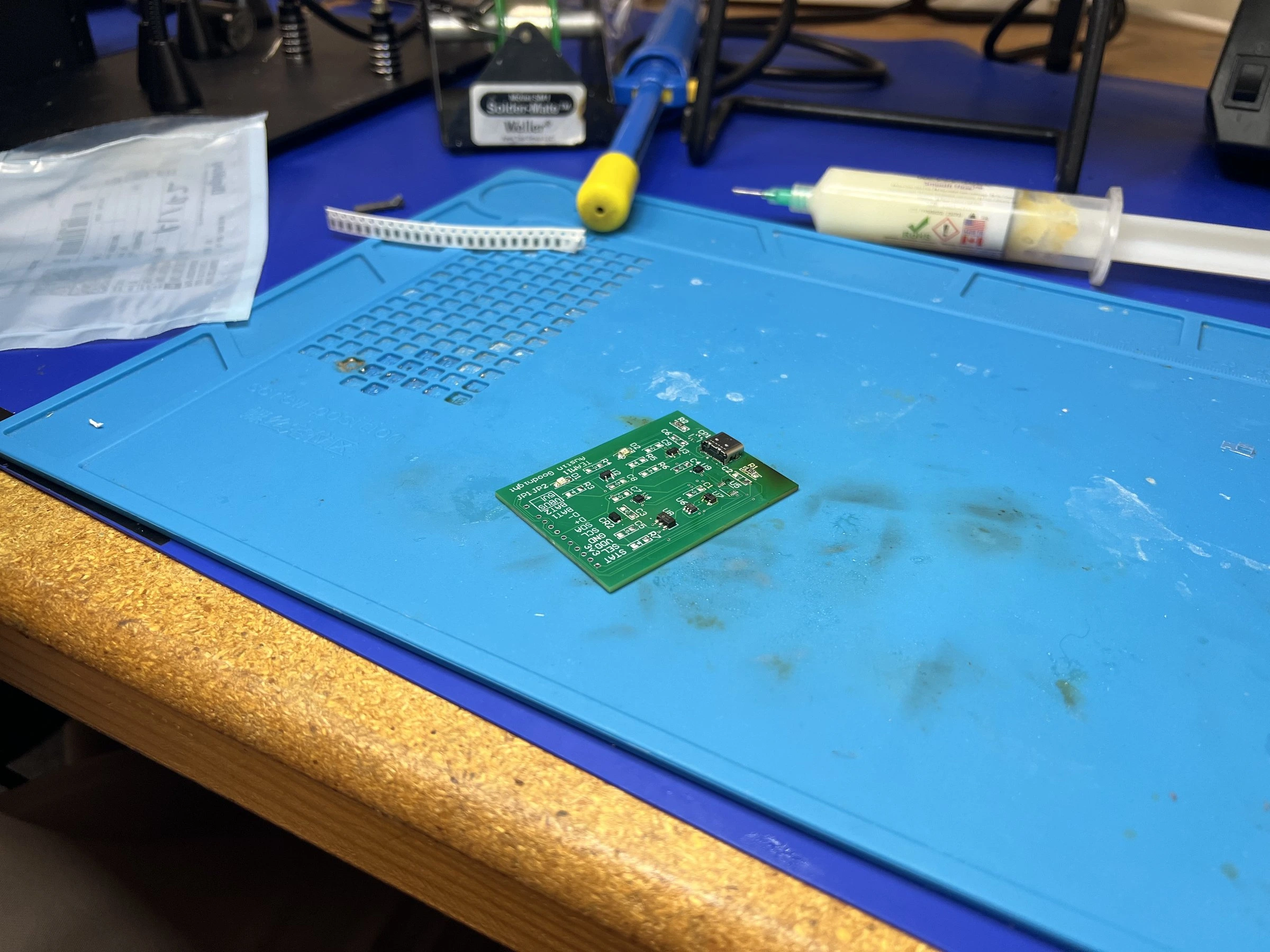
The board was brought up with a staged test plan: the 3.3 V rail first, then each charge channel through series current measurements and the STAT, PROG and VBAT signals. That process isolated a cold solder joint that had disabled one channel, which was then reworked. Dual-battery redundancy was later dropped from the final design, but the board remains a useful study in power-path design.